The Unseen Thread: How a Pop Anthem, a Management Prophet, and an Ancient Verse Weave the Tapestry of True Leadership
In the often sterile, data-obsessed corridors of modern leadership theory, we search for wisdom in bullet-pointed lists, quarterly reports, and the latest AI algorithmic models of human motivation. We look to Silicon Valley disruptors, to titans of industry, to political strategists. Yet, profound leadership lessons those that speak to the soul of the endeavour, not just its mechanics often resides in the most unexpected of places: in the soaring melodies of a 1970s pop chorus, in the pragmatic yet humanistic musings of a management philosopher, and in the timeless, earthy verses of an ancient Tamil culture.
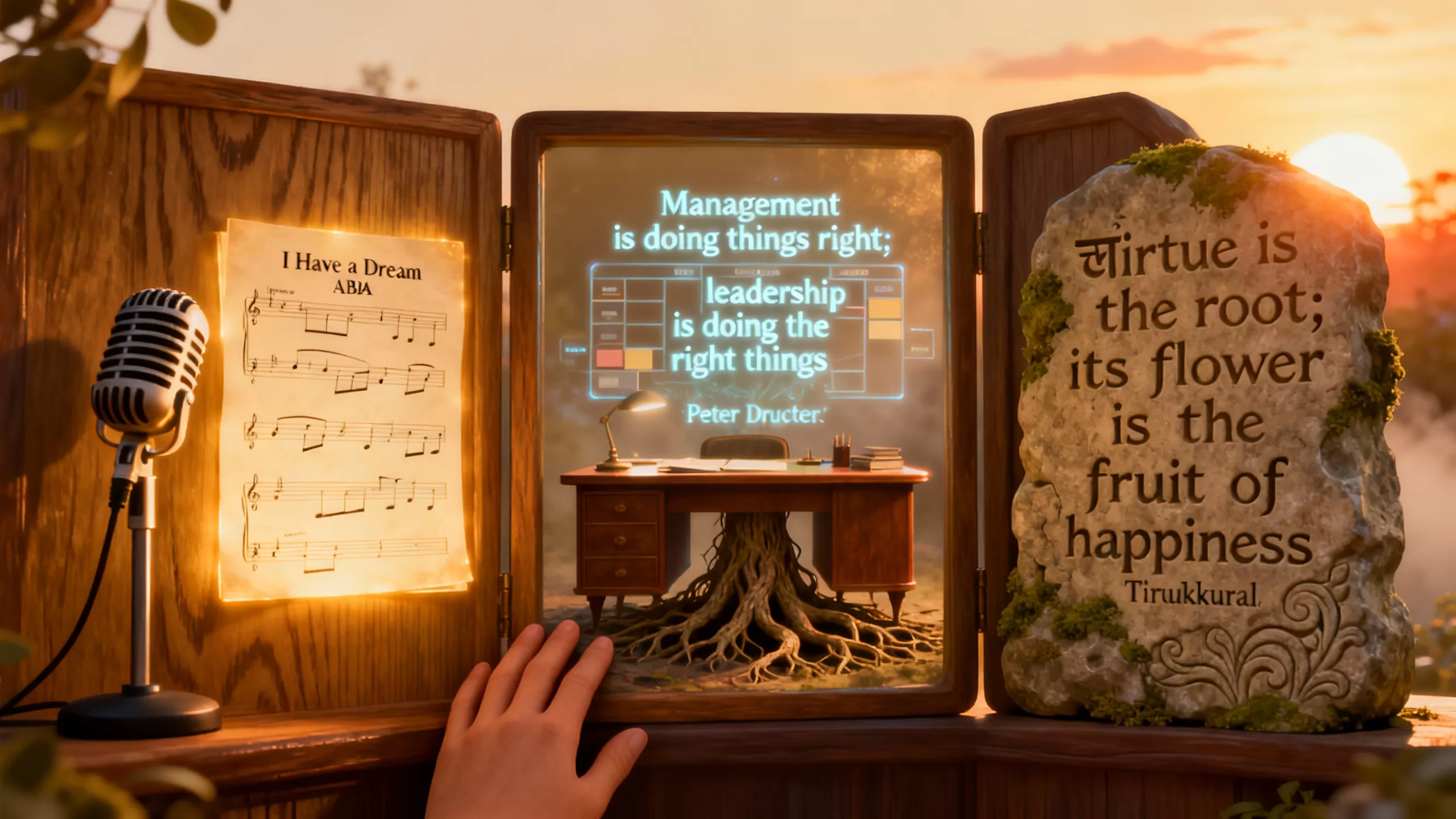
This is an exploration of the hidden thread that connects ABBA’s “I Have a Dream,” the foundational principles of Peter Drucker, and the timeless wisdom of the Tamil philosophical classic, the ‘Tirukkural’. Together, they form a triptych for a leadership paradigm that is at once visionary, effective, and deeply humane.
Part I: The Melodic Foundation – ABBA’s “I Have a Dream” (The Power of Believing)
At first glance, ABBA’s 1979 hit “I Have a Dream” is a simple, sentimental ballad. Its lyrics, written by Björn Ulvaeus, speak of faith, comfort in song, and a persistent, childlike belief in a better tomorrow. “I have a dream, a song to sing / To help me cope with anything,” it begins. The chorus is an anthem of steadfast conviction: “I believe in angels / Something good in everything I see.”
For the cynical leader, this might seem like naïve escapism. But strip away the synthesizers and four-part harmonies, and you uncover a profound leadership truth: “the first act of leadership is the cultivation and articulation of a dream that is felt, not just understood.” The song isn’t about a detailed business plan; it’s about an emotional state—a “song to sing” that provides resilience (“to help me cope with anything”). This is the antidote to the dry, soulless mission statement. A leader’s dream must be a melody that the organization can hum in difficult times. It must be a source of hope, a story that makes the grind meaningful.
Martin Luther King Jr.’s “I Have a Dream” speech derived its power not from policy specifics but from visceral, poetic imagery – “the sons of former slaves and the sons of former slave owners will be able to sit down together at the table of brotherhood.” Similarly, ABBA’s ditty, in its own pop context, reminds us that people are drawn to and motivated by emotional resonance. A leader must be the keeper of that song. They must believe in the “angels”, the latent talent in their team, the positive outcome of a risky venture even when evidence is scarce. This belief becomes contagious. It fosters a culture of optimism and perseverance. The dream is the compass; the song is the morale.
Part II: The Architectural Framework – Peter Drucker (The Discipline of Effectiveness)
If ABBA provides the dream’s emotional melody, Peter Drucker, the father of modern management, provides the sheet music and the rehearsal discipline. Drucker was relentlessly pragmatic. His seminal work, ‘The Effective Executive’, is built on a foundation of disciplined practice, decision-making, and a focus on contribution. He famously declared, “Management is doing things right; leadership is doing the right things.” He shifted the focus from managing things to leading people, from efficiency (doing things right) to effectiveness (doing the right things).
Drucker’s core principles form the essential framework that prevents the dream from devolving into mere fantasy:
1. Focus on Contribution: The effective leader often asks, “What can I contribute that will significantly impact the performance and results of my organization?” This moves the focus inward to one’s own effort and outward to the needs of the team and mission. It aligns perfectly with giving the “song” a purpose to “cope” and to achieve.
2. Play to Strengths: Drucker advised managing by strengths – of oneself, one’s superiors, and one’s team. A leader cannot build on weakness. This requires knowing the “orchestra” who plays the strings of diligence, who the brass of innovation, who the percussion of execution and finally arranging the music accordingly.
3. First Things First: Effective executives concentrate on few, major areas where superior performance will produce outstanding results. They have the courage to say “no” to the trivial many in service of the vital few. This is the prioritization that turns the dream into a strategic plan.
4. The Elements of Decision-Making: Drucker advocated a systematic process: understanding the problem as generic, defining specifications, prioritizing the right over the acceptable compromise, and building execution into the decision. This is the rigorous process that tests the dream against reality.
Drucker’s genius was in creating a system where the subjective “dream” meets the objective world of results. He provides the “how” to ABBA’s “why”. A leader with a beautiful song but no Druckerian discipline is a mere motivational speaker. A leader with Druckerian discipline but no song is just a mere competent administrator, but not an inspirational force. The dream provides the destination and the fuel; Drucker’s principles provide the map and the engine.
Part III: The Ethical Bedrock – The ‘Couplets’ and the Moral Compass
Now we arrive at the deepest, most enduring layer: the ethical foundation. Written over two millennia ago by the Tamil poet-philosopher Thiruvalluvar, the ‘Tirukkural’ is a masterpiece of concise, couplet-based wisdom covering virtue, wealth, and love. Its insights into statecraft, leadership, and personal conduct are staggering in their timelessness. It is here that our leadership framework gains its soul and its moral imperative.
The Kural doesn’t just ask leaders to be effective; it demands they be virtuous. It provides the ethical guardrails that ensure the dream is noble and the discipline is just.
- On the Leader’s Character (Chapter 6 – The Possession of Self-Control): “If a man learns to master his five senses / His enemies’ arrows will cause him no wounds.” (Kural 126). True leadership begins with self-mastery. A leader ruled by anger, greed, or impulse cannot hear the team’s song, much less conduct it. Drucker’s “focus on contribution” requires this internal discipline.
- On Compassionate Justice (Chapter 55 – The Right Sceptre): “The world is his who does not swerve / From justice, mercy, rectitude.” (Kural 546). The leader’s authority (‘sceptre’) is legitimized not by fear, but by fairness (அறம்), mercy (கருணை ), and integrity(நேரமை). This is the ethical framework for Drucker’s decision-making process.
- On Listening and Accessibility (Chapter 43 – Knowing the Quality of Favour): “The king’s ears are the ears of his people; / His eyes, their eyes.” (Kural 543). A leader must be the sensory organ for the organization, listening deeply to the frontline. This echoes the need to understand the team’s strengths and realities, grounding the dream in the truth of their experience.
- On Generosity and Shared Success (Chapter 23 – The Possession of Giving): “Giving to the destitute is true charity; / All other giving expects a return.” (Kural 221). Applied to leadership, this speaks to empowerment and generosity of credit. A leader “gives” opportunity, trust, and recognition without the immediate expectation of return, building immense loyalty and unlocking potential.
- On the Fruits of Righteous Leadership (Chapter 39 – The Quality of a King): “Rain from clouds, rich crops from rain: / These come from a monarch’s righteous reign.” (Kural 560). The ultimate result of virtuous, effective leadership is flourishing—the organization and its people thrive like a well-watered field. This is the realized dream.
- Chapter 6: காமத்துப்பால் – Kāmattuppāl (The Book of Love)
- Chapter 39, 43, 55: பொருட்பால் – Poruṭpāl (The Book of Wealth / Statecraft)
- Chapter 23: அறத்துப்பால் – Aṟattuppāl (The Book of Virtue)
The Tirukkural insists that effectiveness without virtue is hollow and ultimately unsustainable. It answers the critical question: For what end is your dream? Is it for self-aggrandizement, or for the flourishing of the whole? It ensures the Druckerian engine is steering the organization toward a truly good destination.
The Synthesis: The Integrated Leader – Dreamer, Architect, and Sage
Weaving these three strands together, we arrive at a holistic model of leadership:
- The Dreamer (The ABBA Principle): This is the leader’s Heart. They possess and articulate a compelling, emotionally resonant vision—a “song” that provides meaning and resilience. They are the chief believer, radiating a conviction that “something good” can be found and built upon. They foster hope and unite people around a shared, aspirational identity.
- The Architect (The Drucker Principle): This is the leader’s Mind. They translate the emotional dream into actionable reality through disciplined effectiveness. They focus on contribution, leverage strengths, prioritize ruthlessly, and make clear, executable decisions. They build the structures, processes, and culture that enable the dream to be methodically pursued and realized. They ask, “What is the right thing to do, and how do we do it right?”
- The Sage (The Tirukkural Principle): This is the leader’s Soul. They root all action in unwavering ethical principles—justice, compassion, self-control, integrity, and generosity. They ensure that the pursuit of the dream is righteous and that the architectural discipline is applied humanely. They provide the moral compass, earning trust and legitimacy not just through competence, but through character.
A leader operating with only one or two of these dimensions is incomplete:
- Dreamer + Architect, without Sage: A potentially brilliant but tyrannical or unethical leader (the “visionary disruptor” who burns out their team and cuts moral corners).
- Dreamer + Sage, without Architect: A beloved but ineffective leader, a moral compass that points nowhere because the ship lacks an engine (the “inspirational figurehead” who cannot deliver results).
- Architect + Sage, without Dreamer: A competent and ethical manager, but not a transformative leader. They maintain and improve, but do not inspire or pioneer (the “steady hand” who misses the turning point of an era).
The Leadership Symphony in Practice
Imagine a leader facing a profound organizational crisis for example a market disruption or a product failure or a moral scandal.
- The Dreamer in her gathers the team. She acknowledges the fear and pain but immediately begins to sing a new song not of the past glory, but of the comeback story waiting to be written. She talks about the opportunity to redefine themselves, to serve their customers in a new, more authentic way. She reignites belief.
- The Architect in her then gets to work. She applies Drucker: What is the generic problem? Not this one failure, but perhaps our rigidity. What are the right decisions? She makes the tough calls like reprioritizing projects, reallocating resources, restructuring teams based on strengths. She establishes clear, measurable goals for the recovery.
- The Sage in her guides every step. She insists on transparent communication, taking absolute responsibility, and treating those affected by the changes with dignity and fairness (Kural’s “merciful sceptre”). She models self-control under pressure. She ensures that the “comeback” is built on a firmer, more ethical foundation than what came before.
This is the symphony: the Dreamer’s melody of hope floats above, the Architect’s rhythm of disciplined execution drives the work forward, and the Sage’s harmonic foundation of ethics ensures the entire piece has depth, beauty, and enduring value.
Conclusion: The Timeless Tapestry
In our quest for leadership wisdom, we need not look only to the latest business bestseller. Sometimes, the most profound insights are sung by a Swedish pop quartet, systematized by a Viennese-born thinker, and etched in stone by an ancient Tamil poet. ABBA’s “I Have a Dream” reminds us that leadership is, at its core, a deeply human act of faith and storytelling. Peter Drucker provides the indispensable toolkit to turn that faith into tangible results. And the Tirukkural offers the eternal ethical code that ensures those results contribute to a world that is not just more profitable, but also more just, compassionate, and whole.
The true leader, therefore, is a weaver of this timeless tapestry. They have the courage to dream a dream vivid enough to be a song, the discipline to architect that dream into reality, and the wisdom to root it all in virtue. They understand that to lead is to hold all three: the heart’s melody, the mind’s blueprint, and the soul’s compass in exact harmonious balance. In doing so, they do not just build successful organizations; they cultivate fields where people, purpose, and performance can all flourish, like rich crops from a righteous rain.