
Anxieties: Three Tales, One Human Predisposition
We prefer to think of ourselves as people who take measured risks. We use phrases like “I considered my alternatives”, “I erred on the side of caution”, or “I preferred to remain anonymous.” Risk aversion, the propensity to avoid loss even when the potential reward is substantial, lies underneath the complexity of these expressions.
This inclination is not novel. Stock markets, businesses, and performance evaluations were not at its inception. For ages, it has subtly influenced decision-making in royal courtrooms, corporate boardrooms, and even hilarious comedic moments.
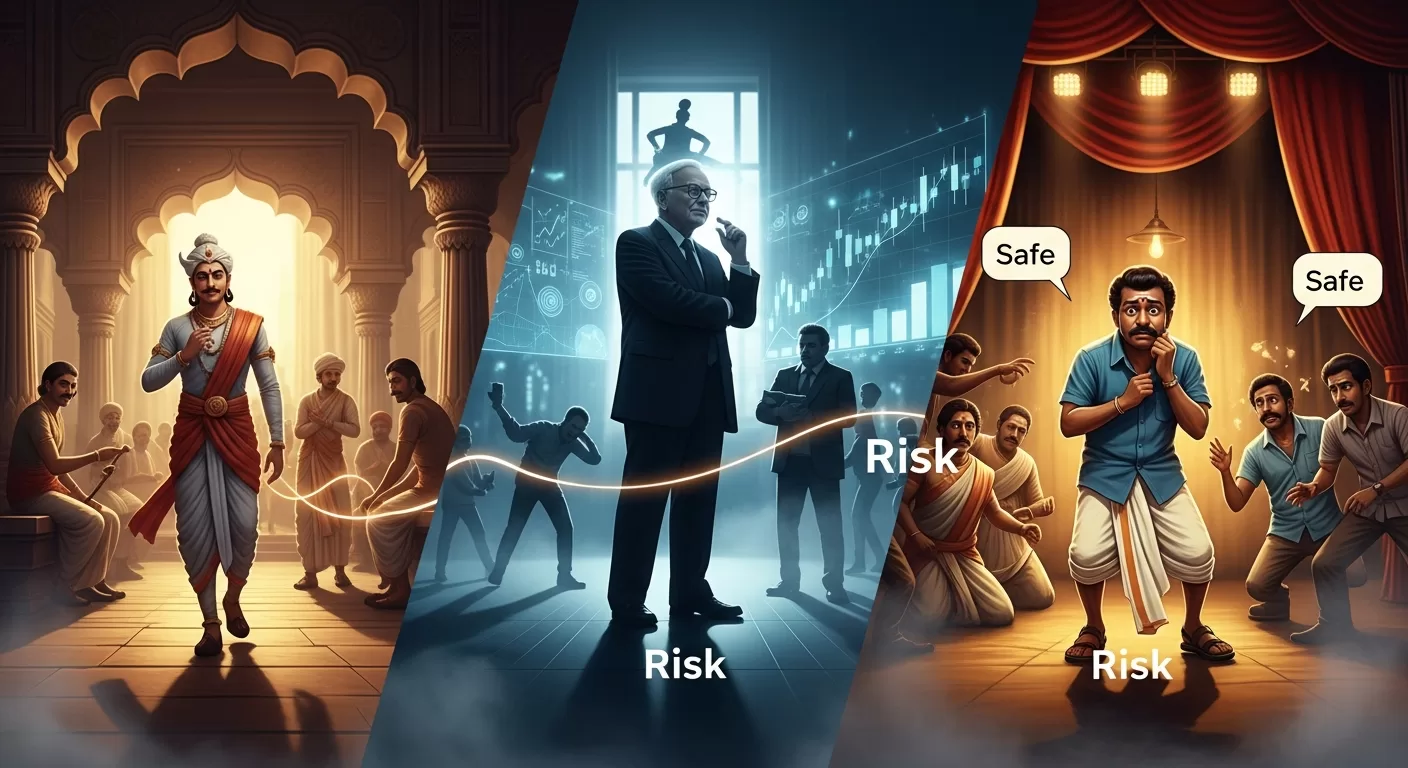
Here are three completely different stories to help you understand risk aversion:
- An account of Tenali Raman’s time at King Krishnadevaraya’s court
- The evergreen wisdom of Warren Buffett
- Many of us remember this Senthil-Goundamani comic scene from our childhoods.
Periods that differ. Diverse situations. A shared characteristic.
Story #1: An Account of Tenali Raman and the Anxieties of Losing Everything Special
Something along these lines happened in a lesser-known Tenali Raman story. A reward has been announced by the king for the person who can solve a difficult challenge. Not many academics are sure.
They murmur to one another:
“What if the solution is incorrect?” “Suppose the monarch finds us funny.” “What if our good name is tarnished?”
However, Tenali Raman moves forward not because he is sure of success but because he knows something deeper: risking inaction also has a cost.
The genius of Tenali, according to several of these accounts, lies not only in his knowledge but also in his capacity to reinterpret danger. While most people worry about losing face (respect, status, and safety), Tenali envisions a different outcome:
- Through setbacks, he gains knowledge.
- If he is successful, he will benefit more than most.
Subtle risk aversion characterises the courtiers. Things like status, credibility, and security are already in their possession. Also, people are significantly more worried about losing their possessions than they are about not having enough of anything new.
Loss aversion in its classic form existed long before the field of behavioural economics gave it that name.
There is no indication of dread in this case of risk aversion. It appears to be sagacity. The truth, though, is that it stealthily obstructs chances.
Story #2: The Irony of “Playing It Safe” and Warren Buffett
Move on a few hundred years to Omaha. A common misconception about Warren Buffett is that he is risk-averse. Indeed, he does say stuff like the following:
- Rule one: Always keep your money.
- Remember Rule No. 1 at all times; it is Rule No. 2.
It seems like a very risk-averse person is behind this.
Still, take a closer look.
- Buffett is not one to shun danger.
- Inadequately recognised risks are avoided by him.
There’s a huge difference.
Volatility is commonly thought of as a sign of danger. There is a direct correlation between Buffett’s view of ignorance and risk. Nearly everyone is afraid of experiencing temporary setbacks. Permanent capital impairment is a concern for Buffett.
Despite his seeming conservatism, this way of thinking allows him to make daring choices:
- Streamlined wagers
- Long holding periods
- Contrary to what the market is currently saying
We feel uneasy with what Buffett teaches us:
- Avoiding loss is not the essence of true risk aversion.
- It’s all about staying away from choices you don’t fully grasp.
The improper kind of risk aversion characterises many modern professionals. They stay away from:
- Making a job change
- Raising one’s hand at meetings
- Taking on ineffective approaches
- Making a concerted effort to learn
Why? The dangers are obvious and pose a threat right now:
- Final verdict
- Transient unpredictability
- Making an attempt
- At the same time, the danger of remaining stationary over time goes unnoticed since it is not obvious.
According to Buffett, risk aversion is more of a mental than an emotional issue.
Story #3: Senthil-Goundamani and the Madness of Being Cautious
Let us return to our comical roots: Tamil film.
Consider the memorable Senthil-Goundamani comedy scenes in which Senthil’s character frantically evades danger. Each time, he goes with the “safe”. option:
- He concurs with all
- To avoid conflict, he
- To a tee, he mindlessly follows directions.
- He makes an effort to blend in.
And yet, despite his best efforts, tragedy still befalls him.
The satire is effective because it reflects reality. “Nothing bad will happen if I don’t take risks,” Senthil thinks. The script and Goundamani’s character teach us the inverse: staying safe doesn’t mean you’ll never have to deal with the fallout. Removing agency is all it does.
Funny as these images are, they reveal a sad truth: you still get an outcome—just not the one you wanted—when you don’t pick.
In the context of organisations, this manifests as:
- “We’ll have to see the outcome.”
- “It has always been this way.”
- “After the next review, we will do it.”
- “Let’s keep things under wraps.”
Regardless, the boat rocks.
Comedic moments both highlight and magnify the truth. When individuals become overly cautious, their intelligence becomes a byproduct of their own narratives.
The One Thing That All Three Stories Have in Common. There appears to be no connection between Senthil-Goundamani, Warren Buffett, and Tenali Raman. However, they all agree on one point: There will always be risks. The decision is up to you.
- When others hesitate, Tenali decides to take action.
- Depth, not comfort, is Buffett’s choice.
- Senthil opts for security, but he ends up losing command.
Extreme caution is not always a negative thing. Its very evolution was a defence mechanism. But it frequently backfires in contemporary life.
Our long-term expenses are underestimated compared to our short-term losses. We prioritise safeguarding our present identity over fostering future expansion. Caution and competence are often conflated.
Leaders and professionals can benefit from this practical lens. A simple technique to diagnose unhealthy risk aversion if you’re leading teams, producing products, or shaping strategy:
Enquire about the following themes:
- Is the decision’s unfamiliarity the reason we’re avoiding it, or is it the danger involved?
- How dangerous would it be to do nothing for the next two or three years?
- Who gains anything by keeping things as they are?
- Are we defending results or pride?
Safe organisations do not do away with risk altogether. Prices, comprehension, and deliberate selection are their hallmarks.
Final Reflection
Anxieties don’t make a grand entrance. A little murmur escapes its lips. It seems like being cautious. It appears mature. Doing so feels like taking on a duty.
Knowing when to step ahead is a sign of wisdom, though, as Tenali Raman demonstrated. Rather than avoiding danger, as Warren Buffett demonstrated, the key is to comprehend it. Playing it safe is sometimes the most dangerous thing you can do, as Senthil-Goundamani delighted us with his antics.
Does the question “Am I risk-averse?” really apply here? Asking, “Am I avoiding loss—or avoiding growth?” is a more pertinent question.
That response alters the course of events.