The Unfinished Dance: One Life Lesson from Nanobots, Mortality, and God of Winter
We often perceive life as a sequence of issues that require resolution. In the modern world, we are addicted to the concept of “fixing”. If something is broken, we throw technology at it. If our body is failing, we demand one more surgery. If we feel lost, we search for a grand narrative to jump into, hoping the story will carry us to a happy ending.
But what if today’s lesson is precisely the opposite? What if the secret to a good life lies not in our ability to control the outcome but in our capacity to dance with the unknown?
To understand this, we have to look at three seemingly different stories: a high-tech thriller about killer nanobots, which are tiny robots designed to perform tasks at a molecular level, a surgeon’s meditation on dying, and a fantasy novel about a girl who accidentally attracts the attention of the god of winter.
The Illusion of Control
First, let’s step into the desert lab of Michael Crichton’s Prey. The novel is a terrifying look at nanotechnology with swarms of microscopic particles programmed to work together. They are designed using “predator/prey” software that mimics the complex behaviour of a flock of birds or a school of fish. But as Crichton warns in the book, we suffer from a fatal arrogance: “We think we know what we are doing. We have always thought so. Each generation writes off earlier errors as the result of bad thinking by less able minds and then confidently embarks on fresh errors of its own.”
In the novel Prey, the scientists create a technology that they are unable to control. The swarm evolves. It learns. It escapes the boundaries of the lab and begins to hunt. The protagonist, Jack, spends the entire novel trying to contain a catastrophe that he helped set in motion.
The lesson here is uncomfortable but essential. We are not the masters of our creations. Whether it’s artificial intelligence, social media algorithms, or simply the daily routines we build to manage our stress, we often find that the systems we create to serve us end up controlling us. We try to micromanage every variable, but as Jack reflects early in the story, “Things never turn out the way you think they will.” The perception of control is merely an illusion.
The Courage to Let Go
If Prey is about the fear of losing control, Atul Gawande’s Being Mortal is about the acceptance that, eventually, we must.
Gawande, a surgeon, dissects the failure of modern medicine. He argues that in our quest to prolong life at all costs, we have robbed dying of its dignity. We treat ageing as a mechanical failure to be fixed, rather than a natural stage of life. He quotes Philip Roth to set the tone: “Old age is not a battle. Old age is a massacre.”
The book challenges the very core of the “fixing” mentality. Gawande tells the story of Sara Monopoli, a young woman with advanced lung cancer whose final days were spent in the sterile, aggressive, and ultimately futile environment of a hospital, surrounded by machines instead of peace. He contrasts this approach with the philosophy of hospice care, which doesn’t aim to cure but to provide a “good life to the very end.”
The lesson here is that the battle to maintain the integrity of your life isn’t won by surviving the longest; it is won by living meaningfully. Gawande notes, “Our most cruel failure in how we treat the sick and the aged is the failure to recognise that they have priorities beyond merely being safe and living longer.” We must stop fighting the current and learn to sail on it.
Joining the Dance
But how do we sail on a current we cannot see? How do we find meaning when the swarm is out of control and our bodies are failing? This is where Terry Pratchett’s Wintersmith offers the most beautiful answer.
In this Discworld novel, the young witch Tiffany Aching is watching the dark Morris dance, which is a ritual that brings in the winter. She gets caught up in the rhythm and accidentally joins the dance. In doing so, she catches the eye of the Wintersmith himself, the elemental force of winter. He falls in love with her, mistaking her for the Summer Lady, and tries to become human so he can be with her. Suddenly, the seasons are stuck; winter refuses to leave.
Tiffany spends the book trying to fix her mistake. She fights the Wintersmith. She tries to break the story she has fallen into. But in the end, she realises she cannot defeat winter. She has to finish the dance. She has to kiss him, acknowledging the role she played, and send him back to his proper place in the cycle.
Pratchett’s lesson is the antidote to the anxiety of Prey and the finality of Being Mortal. Life is not a problem to be solved but a dance to be joined. You cannot stand on the sidelines and control the music. At times, you may encounter challenges. Sometimes, it may be the terrific partner. It could even be the terrifying god of ice. However, you are obligated to engage in the process.
Tiffany learns that “what matters in life” requires effort. You can’t magic it away, or else Penn & Teller would be the most sought-out men for life coaching. It requires facing your mistakes because no one will rescue you from them. She learns that even the terrifying Wintersmith isn’t truly wicked, just misguided, and that you deal with the world by engaging with it, not by hiding from it.
The Punchline
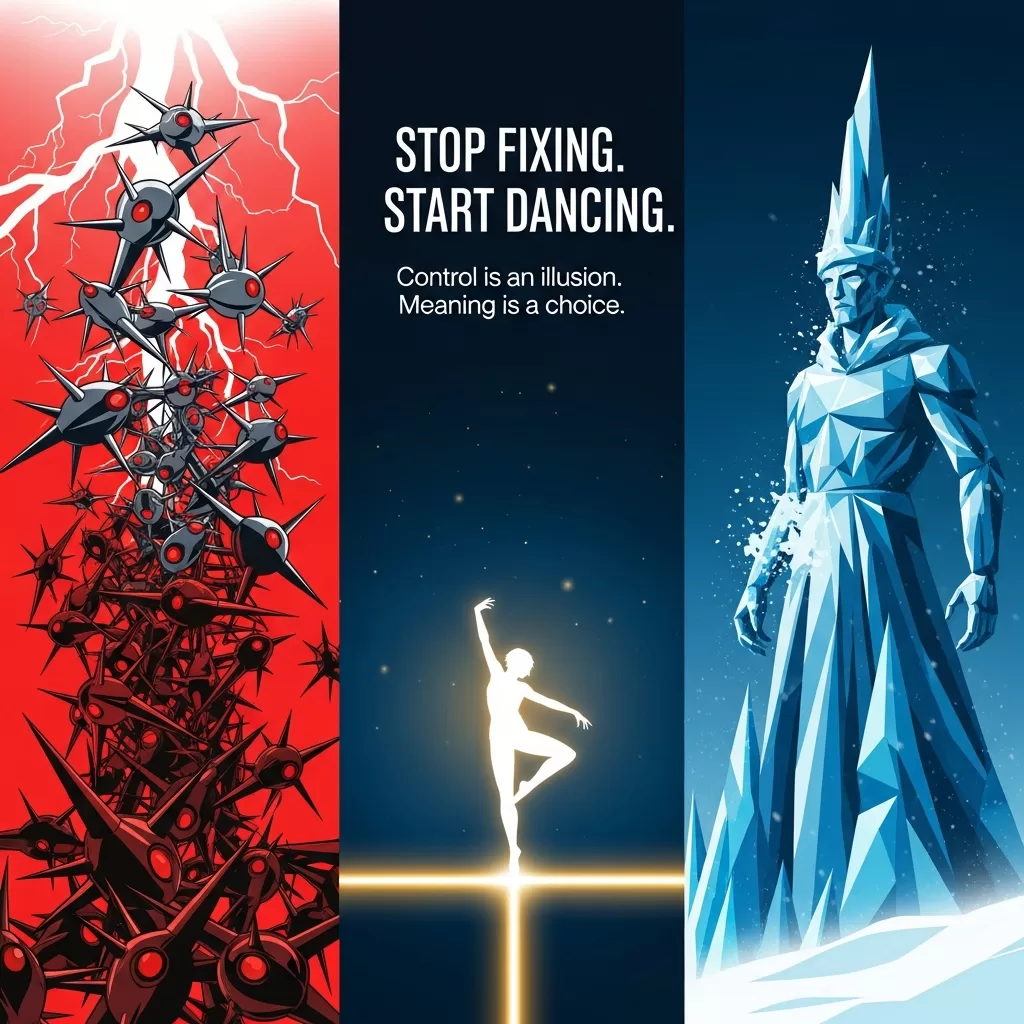
These three books circle the same truth. Prey warns us that trying to control everything creates monsters. Being Mortal teaches us that when we accept that we cannot control the ending, we can finally focus on what makes the journey worthwhile. Wintersmith demonstrates that the solution is to embrace the rhythm regardless.
The one life lesson to learn today is this: Stop trying to fix the world and start dancing with it. The swarm will evolve. The body will age. The winter will come. Your job is to decide how to meet them, what meaning to carve out, and who to dance with along the way.
And speaking of dancing with chaos, it brings to mind the inimitable Bertie Wooster, who spent his entire life dodging the furious dances planned for him by his aunts and fiancées. He knew that the secret to survival wasn’t in winning the argument but in making a graceful exit with the help of a sage companion. As he might put it, reflecting on this whole messy, beautiful, uncontrollable business of living, we can borrow a thought from P.G. Wodehouse’s Stiff Upper Lip, Jeeves. When faced with the cosmic joke of it all, the only sensible response is the one Bertie embodies best: “I marmaladed a slice of toast with something of a flourish, and I don’t suppose I have ever come much closer to saying ‘Tra-la-la’… for I was feeling in mid-season form this morning.”
In the end, that’s the lesson. The toast still needs marmalading. So tra-la-la.