Today’s struggling world requires innovative solutions. The world is grappling with issues such as climate change, resource depletion, and unsustainable consumption practices. Human ingenuity and technological advancement have taken us far. Yet they have also brought about problems that endanger Earth’s fragile ecological balance. Now is the time to learn from nature, not use it as a resource. This is according to Janine M. Benyus’s book. The book is titled “Biomimicry: Innovation Inspired by Nature,” which presents a convincing framework. [A must-read book for all creative people]
Here the idea of “eco-creativity” takes root. A method of problem-solving that is innovative and green. It draws inspiration from the natural world, drawing on its 3.8 billion years of evolutionary knowledge.
Simply put, eco-creativity goes beyond eco-consciousness. Sustainability checklists and CSR initiatives are only the beginning. By posing the fundamental question, “How would nature do this?” we may radically rethink our approaches to design, innovation, and daily life.
The Biomimicry Philosophical Framework
Biomimicry is described by Benyus as the act of trying to mimic the cleverness seen in nature. In terms of efficiency, robustness, and harmony, every single living thing on our planet serves as a model. Nature is a never-ending source of inspiration, from spider silk – which is stronger than steel and can be spun at room temperature without producing harmful by-products – to plants’ photosynthetic activities, which transform sunlight into energy and serve as a constant source of innovation.
Three fundamental principles form the basis of biomimicry:
- Nature as a model: which means to model new ideas after existing ones in the natural world.
- Nature as measure: Examining the ecological compatibility of man-made objects to determine their long-term viability.
- Nature as mentor: which is to honour and study nature instead of destroying it.
These concepts form the basis of the eco-creativity mentality. It shifts focus from human-centred innovations to life-centered designs.
Environmental Innovation in Action
Unlike biomimicry, eco-creativity doesn’t copy nature’s answers. It applies them to real-world human problems in various fields. Let us investigate the many ways eco-creativity emerges in the world of work:
Urban Planning and Architecture:
One of the main sources of carbon emissions is the construction industry. So, eco-creativity wonders how termite mounds handle climate management. The ability of termite mounds in Zimbabwe to keep their interior temperatures consistent regardless of the weather has fascinated architects. The Eastgate Centre in Harare is one example of a structure that has significantly cut energy usage by emulating its natural ventilation systems.
In this case, eco-creativity changes the design philosophy from making insular buildings that fight against nature to making places that work with it.
New Product Development
Nature creates with no waste. In an ecosystem, every output in the end becomes an input. The microstructures of a lotus leaf, for example, allow it to self-clean and repel water. Based on this, researchers have created paints, glass, and textiles with surfaces that repel water and grime.
Designers that engage in eco-creativity incorporate the idea of “closed-loop efficiency” into production processes, rather than mimicking existing forms or textures.
Power Generation
Think about the last energy conversion step, photosynthesis. Besides making oxygen, plants are efficient in converting solar energy into a usable form. Researching ways to make solar panels and energy storage devices that mimic photosynthetic processes is an example of eco-creativity in energy design. Borrowing tactics from nature has the potential to transform renewable energy. As shown in studies of synthetic leaves and bio-inspired solar cells.
Models for Businesses and Organisations
Eco-creativity goes beyond physical inventions. Organisations can model their structures on ecosystems. There is a delicate equilibrium between cooperation and rivalry in a forest. The “wood wide web”, or mycorrhizal network, illustrates how trees pool their resources for mutual support. Like natural ecosystems, businesses that use decentralised, network-based strategies are more resilient.
What Eco-Creativity Is All About Now
Some have used the term “polycrisis” to describe the interrelated problems. Problems plaguing the environment, health, energy, and economy in the modern era. Conventional approaches to innovation worsen it. It puts a premium on efficiency and profitability, making it worse.Eco-creativity offers a paradigm shift.It innovates with the purpose of improving. Improving life, regenerating ecosystems, and sustaining generations to come.
This is significant for three main reasons:
- Adaptability: Over billions of years, nature has survived planetary shifts. In the face of uncertainty, humanity can enjoy learning from such adaptive strategies.
- Resource Efficiency: Nature uses local materials and ambient energy with minimal waste. Hence, it makes it a resource-efficient operator. Eco-creativity encourages us to replicate the same.
- Ethics and responsibility: highlight the interdependence emphasised by eco-creativity. Our planet and its inhabitants are interdependent.
Eco-Creativity: A Creative Approach
A shift in perspective is necessary for eco-creativity to flourish:
- Observation: Research natural systems in their entirety, not superficially.
- Humility: One must realise that technological advancements are not superior to nature at any time.
- System Thinking: Like how ecosystems manage the delicate balance between competition and cooperation, system thinking emphasises the interdependence of many components within larger wholes.
- Using your imagination: be daring and creative when adapting natural strategies to human circumstances.
According to Benyus, eco-creativity is all about “interpreting” and “applying” nature’s knowledge to solve contemporary problems, rather than trying to copy it word for word.
Sustainability in the Workplace of the Future
– Designers will take cues from biomimetic models to make eco-friendly, aesthetically pleasing, and functional products.
– Engineers will rethink materials, production, and energy systems in light of natural efficiencies.
– Leaders will use ecosystem-inspired strategies to fortify their organisations. This kind of innovation will define the future of innovation as industries change.
– Teachers will include eco-creativity into lessons, teaching students to view the natural world as an ally rather than an enemy.
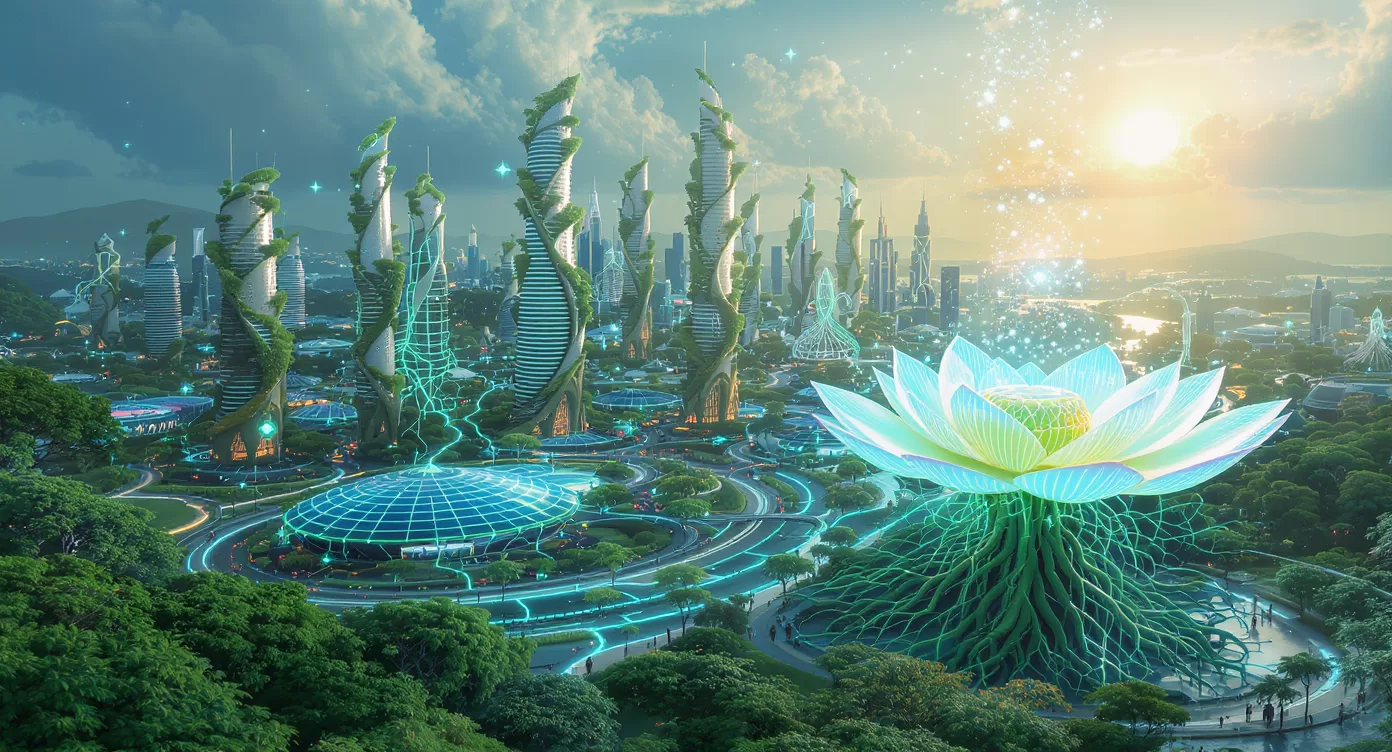
When it comes to human endeavours, eco-creativity has limitless possibilities. Consider a system of supply chains based on the cardiovascular system, a system of waste management modelled after the nutrient cycles in a forest, or an artificial intelligence network modelled after the synaptic efficiency of the human brain. Rather than being science fiction, each of these things is a new reality on the horizon.
An Urge to Take Action (My Wish List)
No one can afford to ignore the need for eco-creativity. We need innovative solutions to succeed in the next decades. We need things that replenish rather than deplete our resources. The foundation of it must be reverence for the living systems upon which our survival depends.
Nature—not labs and offices—presents the ideas Benyus shares in Biomimicry. For instance, these ideas can be found in grasslands, rivers, forests, and coral reefs.This is more than a place to live; it teaches lessons on balance and resilience.
Everyone, from business moguls to creative innovators, has a clear message: look to nature as a guide for your imagination.
In summary
Following the principles of biomimicry, eco-creativity can lead us to a future where environmental health and human progress are in harmony. Enquiring, “How would nature do this?” paves the way for a variety of eco-friendly, life-enhancing solutions.
Adopting an eco-creative mindset allows us to pay homage to Earth’s innate brilliance. It also helps in preparing for the problems of the future. Rather than trying to conquer nature, the key to innovation’s future lies in collaborating with her knowledge while we design.
Ready to design with nature’s genius? Let’s explore how eco-creativity can reshape your work and impact. Book a free session with me and discover how biomimicry can turn your challenges into sustainable opportunities.