


Images, not words, are the medium through which traditional Chinese communicate. It is a pictographic and ideographic language. Oftentimes, the subject or object is not identified, and there is a lack of precise indication of tenses, gender, plural or singular, articles, or prepositions.
One wonderful thing about this technique is that it allows readers to let their imaginations go with the message’s feeling of meaning, rather than relying solely on semantics. Many deeper meanings can be conveyed than what meets the eye since the reader is compelled to engage his vivid imagination and consider the writer’s goal.
Find out how the Chinese word “LISTEN” is formed. (Use the image down here as a guide)

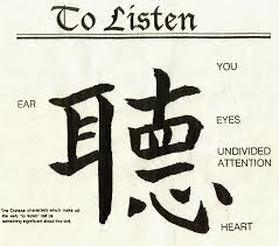
Combining the symbols for “ears,” “eyes,” “heart,” “king,” “solely,” and “fully” forms the word listen. What this means is that you need to use all of your feelings. Sight or eyes, emotions or Heart, love or respect for the speaker, and rapt attention. Only if this ecosystem is in place can you fully immerse yourself in what the speaker is saying.
That is to say, we must practice attentive listening to the fullest extent possible for maximum benefit. The skill of attentive listening has been lost in today’s fast-paced internet society. We primarily tune out in order to respond to the words that are tossed at us.
This is where the ancient Chinese writings offer a few straightforward tips on how to improve the ability to listen.
1. Pay Attention by Ears: Wait for the speaker to finish before you do anything else; breathe deeply and stay focused; your thoughts should not wander. Conventionally, we pay attention just long enough to grasp the main points, and then we jump to numerous conclusions. In this mental state, we begin to plan our response or speculate about the speaker’s next words. Active listening is the practise of engaging your ears while keeping your mind completely open and focused. We shouldn’t judge, guess, criticise, or make assumptions.
2. Listen with your Eyes: Be a Good Listener by Paying Attention Nonverbally (the “Eyes Method”). The Chinese believe that many things are not said during a conversation. This is why we have to keep an eye on the ZEN to get all the information we need, even though they speak very little. Only 7% of a conversation consists of words, 35% of voice intonation and modulation, and 58% of nonverbal clues such as body language, according to studies conducted in the West today. To really listen, we need to pay attention to more than just what is said. We also need to pay attention to what isn’t said and how it is said. A person’s tone and the words they choose to use convey far more significance than the words themselves.
3. Listen Empathetically: Listen from the heart. When the speaker gets to the controversial or upbeat parts of the topic, we must pay attention. Listening with empathy requires us to temporarily assume the position of the speaker (be a what? – A Sakshi to the speaker).
4. Show Respect When Listening: Silence and a small nod of the head can go a long way in making the speaker feel heard. In effect, you’re making him feel like a king by doing this. Regardless of their words, just listen and give them space to vent.
Someone I’m friendly with who isn’t exactly a dashing dude, is young, and isn’t exactly flush with cash or health. Contrary to my expectations, he is constantly in the company of young women. So I sought out his secret sauce, but all he could tell me was that he was born with a talent for attentive listening. That’s the end. Each and every one of the female employees in our building knows they can talk to him about anything – complain, boast, yell, timepass or curse. Just by active listening, he manages to win their hearts.
Consider where you believe this active listening should be implemented?
It’s all over the place, but I think it’s particularly crucial in customer service. While it’s unrealistic to expect us to fix every customer’s issue, we can make a huge impact by improving our communication and listening skills, especially when dealing with frustrated customers.
One of the biggest obstacles is that most people listen not to understand but to respond. We are too eager to start solving problems instead of listening with the intention of understanding. This is in addition to the fast-paced, agile world of technology and life in which we operate. Our typical mental processing speed is 400~500 words per minute, but our spoken word speed is 150~200 words per minute. To compensate, we often multitask while listening or make hasty judgements.
To summarise, here are three essential listening tips:
- Recognise and validate the speaker’s thoughts, sentiments, and feelings.
- Probe and clarify with open-ended questions and encourage the person to speak more to build openness and rapport.
- Share your perspectives and, if necessary, state your stance.
Just listening can convey a lot of meaning. Silence yourself, both within and out. Then, pay attention. You’re bound to reap it’s benefits.
If you think this is a useful or relevant issue, please share it with your friends as well. Listen to me at least once on this matter.


very useful article.
Hi there to every , for the reason that I am genuinely eager
of reading this web site’s post to be updated on a regular basis.
It consists of nice stuff.
constantly i used to read smaller articles which as well clear their motive, and that is
also happening with this post which I am reading here.
Hello There. I discovered your weblog the usage of msn.
This is a really smartly written article. I will
make sure to bookmark it and return to learn extra of your helpful info.
Thanks for the post. I will certainly return.